Extended Info:
Purchase at your own pace without missing out on multiple purchase discounts. Discounts are applied retrospectively, so as you reach each purchase milestone—4, 8, 12, 20, and 40 feeders – all of your current and previous purchases are discounted at the same level.
Note: Discount program amounts include all grain and hay feeder purchases. Creep panels, creep gates, roofs, and other accessories or attachments are not included.
Extended Info:
Purchase at your own pace without missing out on multiple purchase discounts. Discounts are applied retrospectively, so as you reach each purchase milestone—4, 8, 12, 20, and 40 feeders – all of your current and previous purchases are discounted at the same level.
Note: Discount program amounts include all grain and hay feeder purchases. Creep panels, creep gates, roofs, and other accessories or attachments are not included.
Extended Info:
Purchase at your own pace without missing out on multiple purchase discounts. Discounts are applied retrospectively, so as you reach each purchase milestone—4, 8, 12, 20, and 40 feeders – all of your current and previous purchases are discounted at the same level.
Note: Discount program amounts include all grain and hay feeder purchases. Creep panels, creep gates, roofs, and other accessories or attachments are not included.
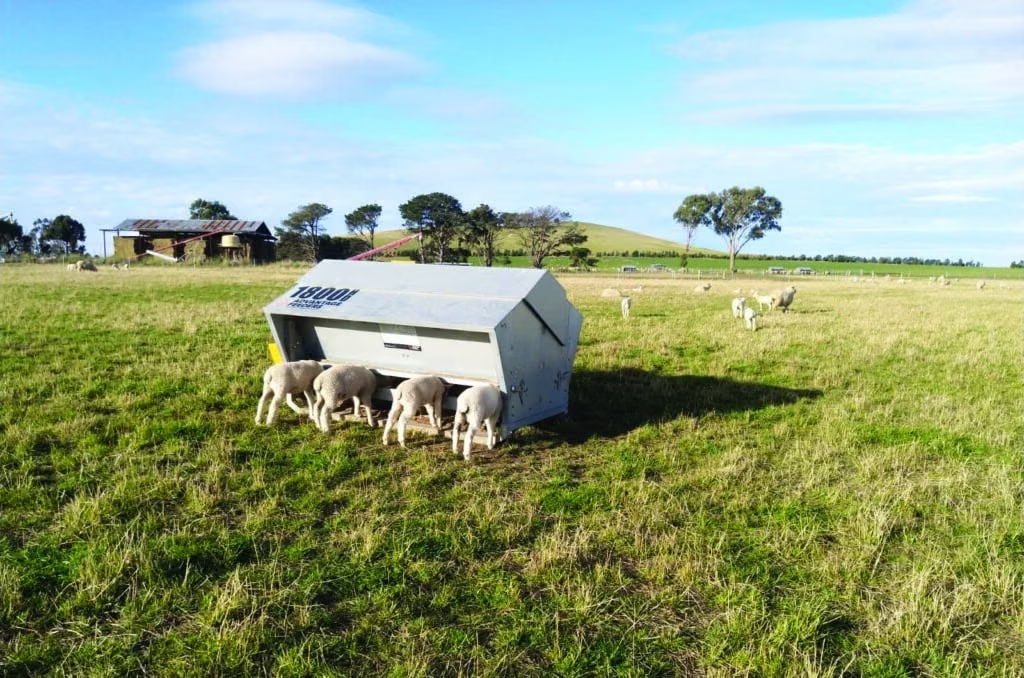
SUPPLEMENT BY 30%. CREEP FEEDING INCREASE WEANING WEIGHT BY 4.02KG/HEAD.
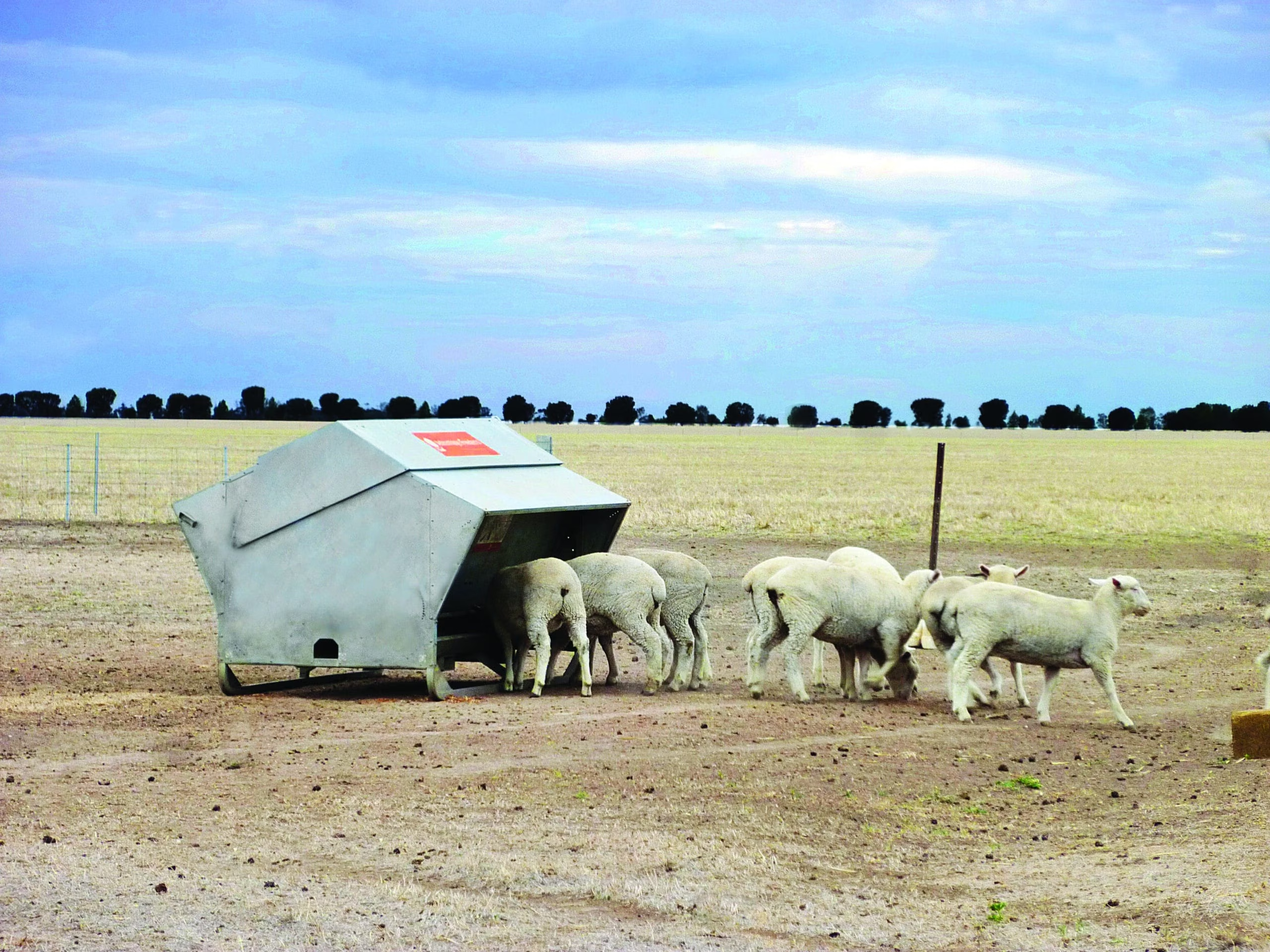
An on-farm trial found that a mob of ewes, supplemented through Advantage Feeders compared to a trial feb mob, required 30% less supplement, had far better rumen performance, produced more lambs and finished with heavier ewes – all with less labour.
The lambs, that creep fed, had higher growth rates enabling them to be sold earlier in the season achieving a higher price/kg.
| PART 1: | Ewe supplementation | ||
| Duration: | 128 days | ||
| Quantity: | 200 in each mob | ||
| Ewe age: | 59% are 4yo. and 41% are 5yo. | ||
| Scanning: | All in lamb with at least 1 foetus | ||
| Maternal breed: | Merino | ||
| Terminal period: | White Suffolk | ||
| Lambing period: | 8/4/15 to 31/5/15 | ||
| Feed type: | barley (12.0MJ/kg, 11.0% protein) | ||
| Feeding amount: | Advantage Feeders group: 22/1/15 to 22/3/15 – 200 grams/day 23/3/15 to 31/5/15 – 400 grams/day Trail feeding group (3 times/week): 22/1/15 to 22/3/15 – 300 grams/day 23/3/15 to 31/5/15 – 600 grams/day Both group: Initial access to approx. 25HA of pasture and then to approx. 25Ha of barley stubbles |
||
| PART 2: | Ewe supplementation | ||
| Duration: | 91 days | ||
| Quantity: | 412 | ||
| Starting age: | 0-50 days (average of 30 days old) | ||
| Breed | 1st cross White Suffolk | ||
| Feed type: | Barley (12.0MJ/kg, 11.0% protein) | ||
| Feeding amounts: | Advantage Feeders group: 1/6/15 to 31/8/15 – 150 grams/days Lambs from trail feeding group: No supplementation |
||
| PART 3: | Lamb dispersal |
| Sale date: | On right |
Richard Leaver, the experiment operator had the following observations throughout the experiment:
The trial went smoothly with a great start to the Autumn break around Easter with 62mm of rain. There were regular moderate amount of follow-up rain with above average winter rainfall and pasture growth.
Before the start of the trial, I was concerned about the potential of mismothering owing to using feeders through lambing – weaning results proved this wasn’t as issue.
The ewes appeared to have bonded well with the lambs before coming on to the feeder as they usually all left with their lambs at foot.
Both groups had very comparable areas of pasture and stubble conditions throughout the trial period and fox baiting was carried out pre lambing. Stick lime was given from December through until lambing.
The only other supplementary feed was three round bales to each group in late March. The condition score of ewes scanning was three. Post lambing, the feeder ewes maintained this score whilst the trail fed ewes dropped half a condition down to 2.5.
The lambs were always at the feeder whenever I checked it. When the feeder was used for creep feeding, the slides were adjusted right open and the lambs just steadily picked away at it.
The creep feeder lambs has potentially better pasture on offer than trail fed mob. Both paddocks had super applied in March but one paddock seemed to have a better clover response.
There was definitely a learning curve for me with set up, positioning and fine tuning of rates in the beginning, but I feel confident I could reduce time taken to do this in the future.
Part 1 : Ewe supplementation: 24/1/15 to 31/5/15 (127 days)
| Advantage Feeders mob | Trail feeding mob | |
|---|---|---|
| Ewe quantity | 200 | 200 |
| Barley consumed (kg) | 7984 | 11514 |
| Barley cost ($250/tonne) | $1,996.00 | $2,878.50 |
| Average daily pasture consumption of dry matter(kg) | 1.5 | 1.5 |
| Grazing days (ewe quantity x days) | 25400 | 25400 |
| Pasture consumption (kg) | 38100 | 38100 |
| Pasture cost ($0.10/kgDM) | $3,810.00 | $3,810.00 |
| No. of feeds/fills | 4 | 55 |
| Average feeding time (hours | 1 | 0.47 |
| Total feeding time (hours) | 4 | 25.85 |
| Feeder moving, set up and adjustment time (hours) | 5 | 0 |
| Total time spent (hours) | 9 | 25.85 |
| Labour and vehicle cost/hour | $60.00 | $60.00 |
| Total labour and vehicle cost | $540.00 | $1,551.00 |
| Lambs marked | 212 | 200 |
| Lambing percentage | 106% | 100% |
| EXPENSES – Period 1 | $6,346.00 | $8,239.50 |
| Advantage Feeders mob | Trail feeding mob | |
|---|---|---|
| Lamb quantity | 212 | 200 |
| Barley consumed (kg) | 2980 | 0 |
| Barley cost ($250/tonne) | $745.00 | 0 |
| No. of feeds/fills | 2 | 0 |
| Average feeding time (hours) | 1 | 0 |
| Total feeding time (hours) | 2 | 0 |
| Feeder moving, set up and adjustment time (hours) | 1 | 0 |
| Total time spent {hours) | 3 | 0 |
| Labour and vehicle cost/hour | $60.00 | $60.00 |
| Total labour and vehicle cost | $180.00 | 0 |
| Average daily ewe pasture consumption of dry matter (kg) | 1.5 | 1.5 |
| Average daily lamb pasture consumption of dry matter (kg) | 0.75 | 0.75 |
| Ewe grazing days (ewe quantity x days) | 18200 | 18200 |
| Lamb grazing days (lamb quantity x days) | 19292 | 18200 |
| Pasture consumption (kg) | 41769 | 40950 |
| Pasture cost ($0.10/kgDM) | $4,176.90 | $4,095.00 |
| EXPENSES – Period 1 | $5,101.90 | $4,095.00 |
| Advantage Feeders mob | Trail feeding mob | |
|---|---|---|
| Average daily ewe pasture consumption of dry matter (kg) | 1.5 | 1.5 |
| Average daily lamb pasture consumption of dry matter (kg) | 1.2 | 1.2 |
| Ewe grazing days until 30/09/15 (ewe quantity x days) |
6000 | 6000 |
| Lamb grazing days* | 3644 | 9300 |
| Pasture consumption | 13372.8 | 20160 |
| Pasture cost ($0.10/kgDM) | $1,337.28 | $2,016.00 |
| EXPENSES – Period 3 | $ 1,337.28 | $2,016.00 |
| Advantage Feeders mob | Trail feeding mob | |
|---|---|---|
| EXPENSES – Period 1 | $6,346.00 | $8,239.50 |
| EXPENSES – Period 2 | $5,101.90 | $4,095.00 |
| EXPENSES – Period 3 | $1,337.28 | 2,016.00 |
| Depreciation* | $348.90 | |
| Total EXPENSES** | $13,134.08 | $14,350.50 |
| Total LAMB INCOME*** | $29,750.00 | $26,049.00 |
| NET PROFIT | $16,615.92 | $11,698.50 |
* This is calculated by multiplying the depreciation rate of 15% by the investment of $2326 for one NGF3800 with
Creep Panels.
** The expenses of shearing, the depreciation of the ewe value, lambing marking, injections, shepherding, etc.
where not added into the expenses
*** No wool income was added into the…
A key driver in the profitability of a prime lamb enterprise is the ability to get lambs to market early, before the annual flush of lambs hit. This trial showed lambs that were sold before 11/9/15, sold in the range of $147-$150. Lambs sold after that date at a significant discount. The Creep fed group had 150 lambs reach marketable weight in the peak price period while the control group only achieved 75 lambs.
Part 1: Ewe supplementation
The ewes supplemented with Advantage Feeders consumed 30% less grain and ended up an average of 1.4kg/head heavier.
Part 2: Lamb creep feeding
At the end of this period, the lambs that had been creep fed averaged 47.83kg/head while the lambs that had no supplement, the control group, averaged 43.81kg/head.
The lambs were supplemented with an average of14.06kg of barley, achieving a supplement feed conversion of 3.5:1.
Part 3: Lamb dispersal
The creep fed lambs reached market weight earlier than the control group. The creep fed lambs averaged $140.33/head while the control group, averaged $130.25 – a $10.08/head difference.
After weaning, the creep fed lambs only required 3644 grazing days on the farm while the control group required 9300.
The Advantage Feeders system and the use of one feeder increased net profit by $4,917.42
At the beginning of the trial (22/1/15), the Advantage Feeders mob had an average weight of 71.5kg and the trail fed mob was 70.8kg. At the completion of the trial (31/5/15), the Advantage Feeders mob had an average weight of 72.0kg and the trial feb mob was 69.9kg – a net gain of 1.4kg for the Advantage Feeders mob.
The net weight gain was achieved through a feed consumption of 11,514kg of barley for the trail fed mob and only 7,984kg by the Advantage Feeders mob.
The ewes from the trail feeding mob had 200 lambs at marking (3/6/15), whereas the Advantage Feeders mob achieved 212 lambs – 6% higher.

The creep feed lambs only ate an average of 35g/day for the first 14 days of the trial due to the restricted settings of the feeder. If the setting were ad-lib, the lambs could consume more, enabling an even earlier developed rumen that this trial and gain more weight.
Recent Advantage Feeders trial have shown that the rumen efficiency gained by regular and small amounts of supplementation have led to decreased pasture consumption, allowing more stock/Ha to be run.
With ewes from the Advantage Feeders mob gaining 1.4kg over the trial feb mob, the supplement feeding amount could be reduced from 69% in this trial to 55%. This would save over $400 extra for a mob of 200 ewes.
We conduct on-farm trials to test and demonstrate the effectiveness of our products. Each trial provides practical, evidence-based insights that guide our work and support informed decision-making.
Advantage Feeders was developed in Australia and is now used by livestock producers throughout the United States and around the world.
With a head office in Carthage, Missouri, a warehouse in Paden, Oklahoma, and a network of strategically located distributors, Advantage Feeders products are available across the USA.
Our range includes controlled grain and pellet feeders for cattle, sheep and goats, along with creep-feeding and hay-feeding solutions designed to help producers improve feed efficiency, pasture utilization and livestock performance.
Advancing Ruminant Production
Help livestock farmers double meat production with the same level of inputs
Through continual research and development, we strive to provide livestock farmers with the world’s best controlled feeding products, knowledge and systems that allow them to achieve the highest return on investment