Extended Info:
Purchase at your own pace without missing out on multiple purchase discounts. Discounts are applied retrospectively, so as you reach each purchase milestone—4, 8, 12, 20, and 40 feeders – all of your current and previous purchases are discounted at the same level.
Note: Discount program amounts include all grain and hay feeder purchases. Creep panels, creep gates, roofs, and other accessories or attachments are not included.
Extended Info:
Purchase at your own pace without missing out on multiple purchase discounts. Discounts are applied retrospectively, so as you reach each purchase milestone—4, 8, 12, 20, and 40 feeders – all of your current and previous purchases are discounted at the same level.
Note: Discount program amounts include all grain and hay feeder purchases. Creep panels, creep gates, roofs, and other accessories or attachments are not included.
Extended Info:
Purchase at your own pace without missing out on multiple purchase discounts. Discounts are applied retrospectively, so as you reach each purchase milestone—4, 8, 12, 20, and 40 feeders – all of your current and previous purchases are discounted at the same level.
Note: Discount program amounts include all grain and hay feeder purchases. Creep panels, creep gates, roofs, and other accessories or attachments are not included.

The primary objective of creep feeding is to transform infant lambs to have the ability to convert pasture, other forages and supplements into nutrients. This results in higher growth rates.
| Average lambing date: | 25th of August |
| Average age of lambs at commencement of creep feeding: | 15 days |
| Duration of creep feeding: | 115 days |
| Breed: | Poll Dorset rams over Merino ewes producing 1st X lambs |
| Ewes per group: | Creep feeding group: 90 Control group: 157 Both groups were stocked at 7.7ewes/Ha |
| Feed type: | Barley |
| Target feeding quantity: | Avg. of 200g/lamb/day |
| Mineral supplementation | CalMag offered to both groups for the duration of the experiment |
| Ewe supplementation | The ewes in the creep feeder group were supplemented with barley to train their lambs. All this supplement has been attributed to the lambs |
| Pasture type | Ryegrass and clover |
Graham Klemke, the experiment operator, had the following observations throughout the experiment:
| Cost of feed per tonne delivered | $250 |
| Avg. daily intake – 115 days (g/lamb/day) | 198 |
| Total avg. intake per lamb (kg) | 22.77 |
| Avg. cost of feed per lamb | $5.69 |
| Avg. daily weight gain over control group | 83 |
| Total additional weight (kg/lamb) | 9.6 |
| Feed conversion* | 2.37 |
| Avg. gain in value over control group per lamb (@$4.00/KgLW) | $38.40 |
| Net profit per lamb** | $32.71 |
* Feed conversion: Kilograms fed to achieve 1kg of liveweight gain.
** Note: This does not include filling, monitoring or depreciation costs.
Creep feeding can have a very efficient
feed conversion
As pasture is often the most cost-effective feed source, once the rumen is developed, livestock can absorb nutrients from this feed source and prompt growth in a cost-effective manner. This is because the additional growth not only comes from the creep feed intake but also the added pasture consumption. The experiment showed that the creep fed lambs weaned 9.6kg heavier after an average consumption of 22.77kg of barley, having a very efficient feed conversion of 2.37.
The creep feeding group and the control group were set up with the same proportion of twins and single ewes. The control group weaned 188 lambs from 157 ewes equating to a weaning rate of 120%. The creep feeding group weaned 132 lambs from 90 ewes equating to a weaning rate of 147%. This difference has led to a significantly higher income and profit per hectare that have not been included in the calculations of increased profit from creep feeding.
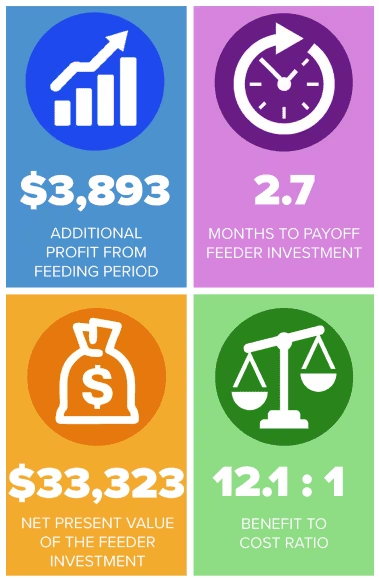
The experiment shows that the creep fed group of 132 lambs grew considerably faster than the control group and were more profitable. Using the values observed during the experiment and calculating the profit for 200 lambs, a return of $3,893 is possible for a feeding period of only 115 days. This return would see an Advantage Feeders 1800HD with Creep Panels paid off in as little as 2.67 months. Significant annual gains can be gained by expanding creep feeding across all mobs within a commercial farm.
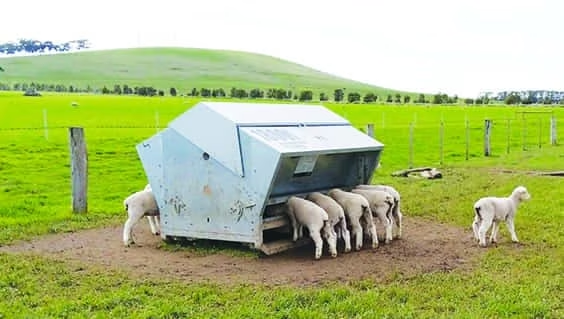
We conduct on-farm trials to test and demonstrate the effectiveness of our products. Each trial provides practical, evidence-based insights that guide our work and support informed decision-making.
Advantage Feeders was developed in Australia and is now used by livestock producers throughout the United States and around the world.
With a head office in Carthage, Missouri, a warehouse in Paden, Oklahoma, and a network of strategically located distributors, Advantage Feeders products are available across the USA.
Our range includes controlled grain and pellet feeders for cattle, sheep and goats, along with creep-feeding and hay-feeding solutions designed to help producers improve feed efficiency, pasture utilization and livestock performance.
Advancing Ruminant Production
Help livestock farmers double meat production with the same level of inputs
Through continual research and development, we strive to provide livestock farmers with the world’s best controlled feeding products, knowledge and systems that allow them to achieve the highest return on investment